
What Did San Antonio Discover in Game 6?
The final score explained who advanced. It did not explain why. An investigation into the adjustment that reshaped the Western Conference Finals.
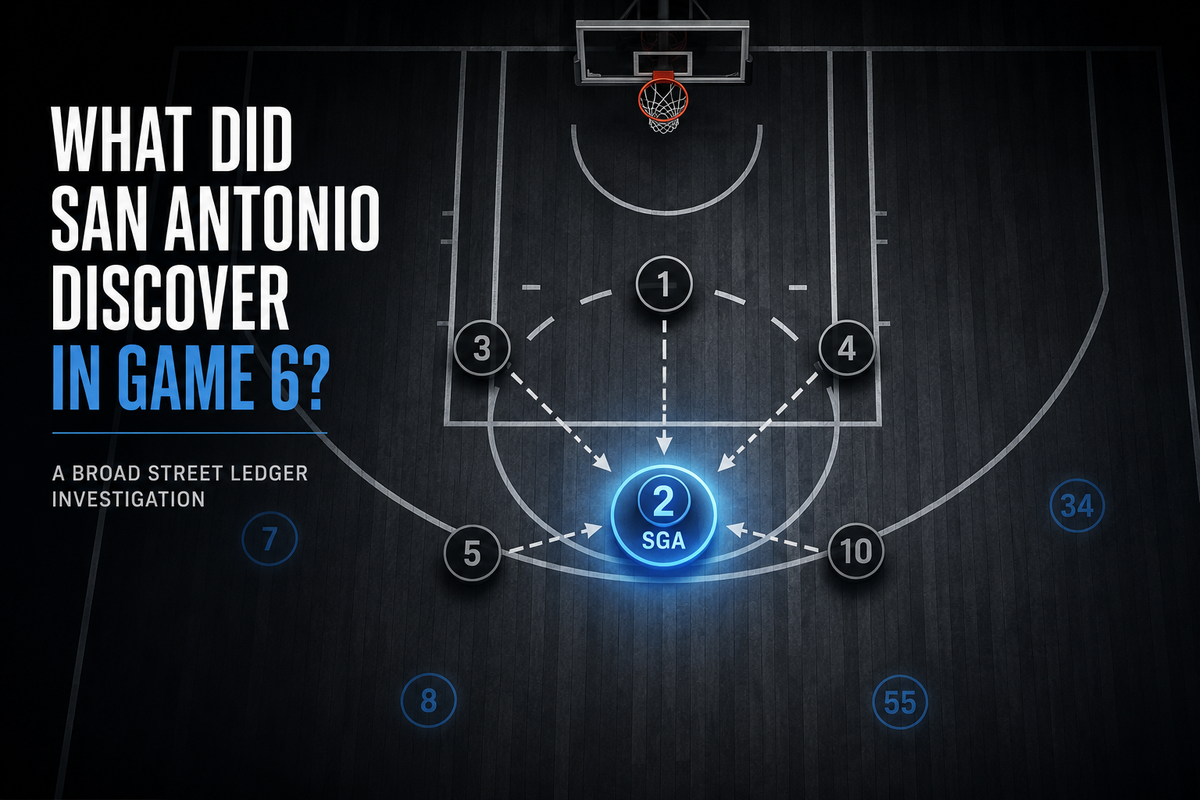
The Spurs won Game 7. That's how the series will be remembered. But the more interesting question may be what happened two nights earlier.
Game 6 ended 118–91. At first glance, it looks like one of those games that occasionally appears in the playoffs—a team goes cold, another team gets hot, and the result gets filed away as an outlier. But Game 7 makes that explanation harder to accept. When the same problems reappear immediately afterward, it's worth asking whether Game 6 was less an aberration and more a discovery.
The obvious explanation is that San Antonio found a way to stop Shai Gilgeous-Alexander.
The evidence suggests otherwise.
Shai remained productive. Even in Game 7, he scored 35 points and handed out 9 assists. That's usually the profile of a player whose team wins. If the Spurs had truly solved him, the numbers would likely look different. Instead, the Thunder's offense seemed to become less connected around him.
The turning point may have come in the third quarter of Game 6.
Oklahoma City scored just 13 points in the period and went nearly eight minutes without a field goal. Droughts happen. Eight-minute droughts in a conference finals elimination game usually indicate something deeper. The Thunder did not simply miss shots. They struggled to generate answers.
That's where the absence of Jalen Williams begins to matter.
Without Williams, Oklahoma City's offense became easier to organize defensively. The Spurs no longer had to account for the same level of secondary creation. More possessions flowed through Shai. More responsibility landed on supporting pieces. More decisions had to be made by players who are most effective when operating within the flow of the offense rather than carrying it.
The result was an offense that increasingly resembled a one-creator system.
This may also explain why so much attention settled on Chet Holmgren after the series. Holmgren's production declined, but focusing on the stat line risks missing the larger point. The question is not whether Chet disappeared. The question is whether San Antonio successfully forced Oklahoma City's supporting cast into roles they were less equipped to handle.
By the end of the series, that appears to be exactly what happened.
The Spurs did not need to shut down Shai. They needed to reduce the number of ways Oklahoma City could threaten them. Once the offense narrowed, every possession became slightly more predictable. Passing windows shrank. Rotations became cleaner. The Thunder still had their best player. They just had fewer ways to connect him to the rest of the team.
That's why Game 6 remains the most important game of the series.
Game 7 delivered the outcome. Game 6 revealed the mechanism.
The Spurs did not stop Shai Gilgeous-Alexander.
They isolated him.