
The Game Everyone Will Remember Didn't Start in the Fourth Quarter
Most fans will remember the Knicks’ late 11-0 run in Game 1. The win probability chart tells a different story—one that begins eight minutes earlier in the third quarter.
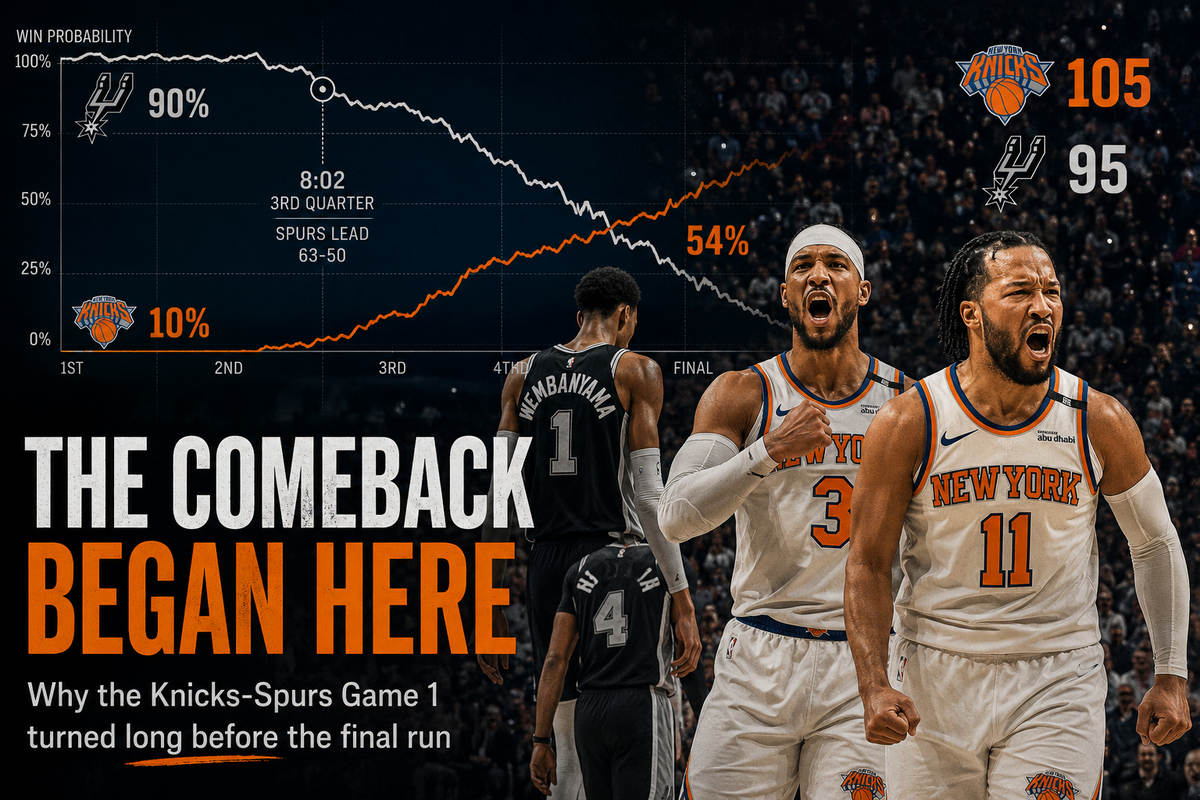
Looking at the final score—Knicks 105, Spurs 95—one can imagine all sorts of stories. Jalen Brunson taking over late. The Knicks finding another gear in the closing minutes. San Antonio collapsing under the pressure of the NBA Finals.
Those things happened. They are all part of the story.
But they may not be the story.
After the game, I found myself staring at the win probability chart rather than the box score. The chart suggested something unusual. The decisive stretch of Game 1 may not have occurred during the Knicks' dramatic 11-0 closing run. It may have begun much earlier, with 8:02 remaining in the third quarter.
At that moment, Stephon Castle tipped in an offensive rebound to give San Antonio a 63-50 lead. The Spurs' win probability climbed to roughly 90 percent. For all practical purposes, they had New York on the ropes. The crowd was engaged, Victor Wembanyama was controlling the paint, and the Knicks' offense looked stuck.
Most fans watching live would have identified that as San Antonio's high-water mark.
They would have been right.
What they could not know was that the game had already started to turn.
The strange thing about the comeback is that there was no single catastrophic possession. No dramatic injury. No sudden ejection. No moment where the Spurs completely fell apart.
Instead, they simply failed to finish the job.
Wembanyama missed.
Castle missed.
Harper missed.
The Spurs committed an offensive foul turnover. More shots failed to fall. Possession after possession passed without San Antonio extending the lead. They had created separation, but they never delivered the knockout punch.
Meanwhile, the Knicks began chipping away.
Karl-Anthony Towns repeatedly found his way to the basket. Josh Hart started appearing everywhere at once. Rebounds. Assists. Steals. Hustle plays. The sort of contributions that rarely make highlights but often decide games.
Notably absent from this stretch was Brunson.
The eventual hero of the fourth quarter was not yet carrying the offense. The comeback was built instead through persistence and possession-by-possession attrition.
One sequence stands out.
With the Spurs still leading, De'Aaron Fox turned the ball over. Hart came away with the steal. Moments later, Landry Shamet buried a three-pointer.
The scoreboard barely moved.
The feel of the game changed completely.
For the first time in several minutes, San Antonio looked vulnerable.
By the end of the third quarter, the game was tied 76-76.
The Spurs' win probability had fallen from roughly 90 percent to nearly a coin flip.
That swing may ultimately prove more important than anything that happened in the fourth quarter.
There will be plenty of discussion about Brunson's late-game brilliance, and deservedly so. Great players finish games, and Brunson finished this one. But the difficult work had already been done. New York had climbed from the edge of defeat back into the contest long before the final run arrived.
Fans tend to remember the dramatic moments. They remember the dagger shots, the celebrations, the final possessions. And who can blame them? Those moments make for better stories.
But Game 1 offers a reminder that the most important stretch of a game is not always the most memorable one.
Many people will remember the Knicks' 11-0 run to close the game.
The win probability chart tells a different story.
It suggests that the Finals opener was won during eight largely forgotten minutes of the third quarter, when the Spurs stopped extending the lead and the Knicks quietly took control of the game.
By the time the fourth-quarter heroics arrived, the comeback was already underway.